Business 382
Dealer Lists Low-Mileage 2017 Ferrari 488 Spider Imported From Canada
In this issue
Business 382
Dealer Lists Low-Mileage 2017 Ferrari 488 Spider Imported From Canada
Culture 403
1992 Porsche 911 Turbo With 3.5-Liter Engine Listed for Sale in New Jersey
Economy 53
Oil prices fall on hopes of easing Iran conflict
News 171
Britons stock up on tinned food and bottled water after Be Ready campaign
Politics 125
Musk’s reported $474 million political ad spend contrasted with alternative car p…
Sports 305
Gill Bowls First as Rain Cuts Hamilton ODI to 40 Overs
Technology 366
Fourteen MEPs Ask EU to Probe Security Risks of BYD Cars
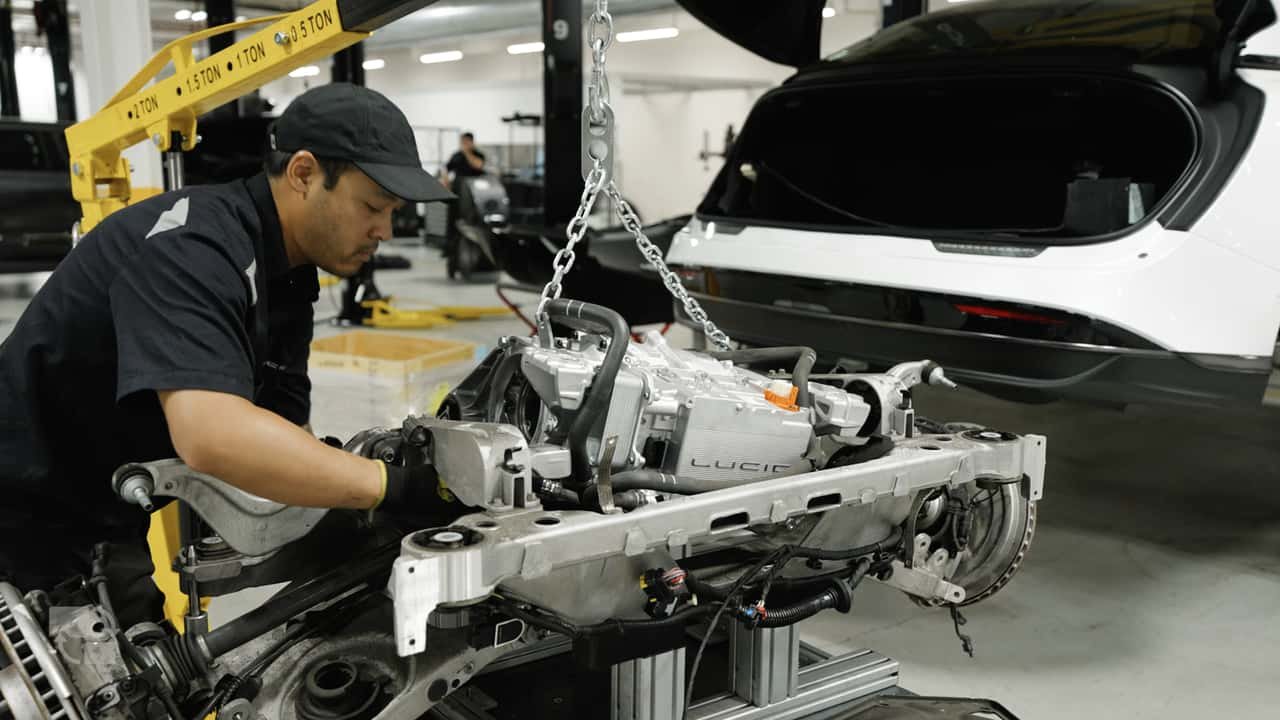
Lucid says service wait times fell 20 per cent in the third quarter as it rapidly expanded its service staff, and it plans new centres in Southern California, Dallas and the Chicago suburbs.
By Eleanor Ellington · 4 min read
Lucid says it has cut service wait times by 20 per cent in the third quarter, a result the electric vehicle maker credits to a sharp expansion of its service workforce. The company has acknowledged that it had underinvested in service, a shortcoming that had become increasingly visible to owners of its vehicles. The admission is unusually direct for a manufacturer that has been building out its lineup and sales network while service capacity lagged behind.
According to the company, the number of technicians and service-support staff grew by more than 40 per cent in a single quarter. Lucid links that hiring push directly to the improvement in waiting times, which it says were reduced across its markets globally rather than in a single region. The figures were reported by Electrek, drawing on Lucid's own statements, and the company's figures on staffing are presented as company-reported numbers rather than independently audited data.
The problem had grown visible to Lucid owners in the period before the improvement, and long waits for repairs and maintenance can weigh heavily on owner satisfaction. In the premium electric segment, where ownership experience is closely watched, service quality can influence whether buyers return to a brand for their next vehicle. Lucid's decision to address the issue publicly suggests the company sees that risk as serious enough to answer in its own words.
The company has set out a series of physical expansion plans to support its service network. New Studio and Service Centres are planned in Southern California, with additional centres proposed for the Los Angeles area. Lucid has also announced plans for a location in Dallas and another in the Chicago suburbs. Those sites would extend the company's service footprint beyond its established hubs and into regions where owners currently depend on longer journeys or mobile support.
Alongside the fixed sites, twenty more Gravity Mobile Service vans are being added to the fleet. The mobile units are intended to reach customers who cannot easily travel to a centre, allowing some service work to be carried out closer to where vehicles are kept. Taken together, the mobile vans and the planned centres represent two parts of the same strategy: adding capacity in the places where demand is growing, and reducing the distance owners must travel to get a vehicle seen.
Several details remain unclear. The methodology behind the 20 per cent wait-time figure has not been described in the available reporting, so it is not known how waiting times were measured or over what baseline period the reduction was calculated. The expansion plans are drawn from Lucid's own announcements, and independent verification of them has not been indicated. Nor is there a published timeline in the available notes for when the Dallas and Chicago sites are expected to open.
Whether the gains in wait times will hold as the company grows its customer base will be a key test of the investment it now says it is making. Adding technicians quickly is one step; retaining them and keeping pace with a growing number of vehicles on the road is another. For owners, the practical measure will be how long they wait when their vehicle needs attention, and whether that improvement can be sustained once the new staff and sites are fully in operation.
Source: insideevs.com
17