
Business 165
Ram's Entry-Level Rumble Bee Sells Out in 90 Minutes
In this issue
Business 165
Ram's Entry-Level Rumble Bee Sells Out in 90 Minutes
Culture 187
Porsche 718 Cayman GT4 RS with Weissach Package and $230,885 Sticker Heads to Auc…
Economy 35
US Weighs Wider Red-Dyed Diesel Sales to Cut Record Fuel Prices
News 140
Kasparov Warned His Life Is in Danger, Says US and Lithuanian Security Services
Politics 109
Mahmood Opens New Legal Refugee Routes in Labour Conference Speech
Sports 253
Ford Confirms Return to World Rally Championship for 2028
Technology 206
BMW Teases New Long-Wheelbase Models for China Through 2027
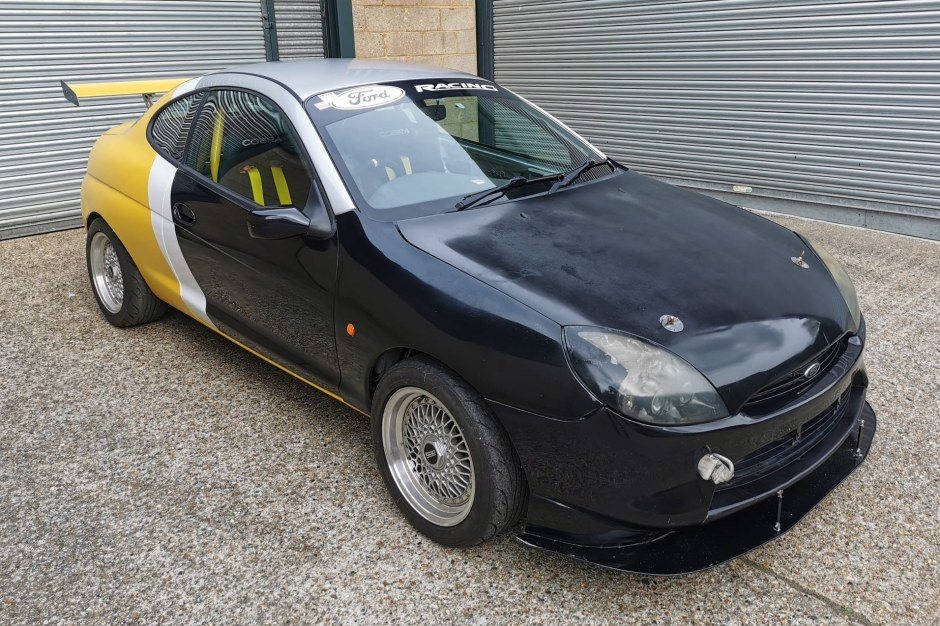
A 2001 Ford Puma, first registered in the UK and later converted into a race car, is being offered for sale in Guildford with a stripped cockpit, racing suspension and a 1.7-litre VCT engine.
By Charlotte Redford · 4 min read
A 2001 Ford Puma that began life as a road car in Britain and was subsequently transformed into a circuit racer is now being offered for sale in Guildford, England. The right-hand-drive coupe, first registered in March 2001, has been stripped and modified for competition use, and it comes with a pair of British number plates and a UK V5C registration document.
The car is finished in silver beneath a black, white and yellow vinyl wrap, and its exterior has been altered for track duty with an adjustable front splitter, a rear wing, hood pins and front and rear tow straps. It rides on multi-piece BBS wheels fitted with Nankang tyres. Braking is handled by power-assisted front discs sourced from a second-generation Mondeo ST220, paired with rear drums. The seller notes that the suspension springs were cut under previous ownership, and that the car will require weld repairs on its rocker panels before it can pass a British MOT inspection. Rust is also visible on various areas of the underside.
Inside, the cockpit has been stripped for racing. A yellow bolt-in roll bar sits behind a pair of black-trimmed Cobra racing seats equipped with TRS harnesses. A Sparco steering wheel frames white-dial instruments including a 140-mph speedometer, a 7,000-rpm tachometer and readouts for engine temperature and fuel level. Additional gauges for water temperature, oil pressure and oil temperature are mounted in the centre of the dashboard. Racing equipment includes a push-button starter, a battery cut-off switch, a fire extinguisher and a rear strut tower brace. The battery has been relocated to the rear cargo area, while the factory digital clock and power windows have been retained. The brake-bias adjustment knob has not been tested under the seller’s ownership.
Power comes from a 1.7-litre VCT inline-four, factory rated at 123 horsepower and 116 lb-ft of torque, mated to a five-speed manual transaxle driving the front wheels. Under previous ownership, a cold-air intake, an aftermarket exhaust, an oil sump guard and a MOMO strut tower brace were installed. The digital odometer shows 110,000 miles, only a handful of which were added by the seller, who acquired the car in April 2023. The Check Engine light is currently illuminated, and the last valid MOT expired in June 2023.
The Ford Puma was designed by Chris Svensson for Ford of Europe and employed the company’s New Edge design language. It was built at Ford’s Cologne plant in Germany for the European market, and approximately 133,000 examples were produced between 1997 and 2001. This particular car left the factory in silver, and the seller says replacement front panels finished in black were installed under previous ownership. Dents and other imperfections are visible in the gallery accompanying the listing.
The sale offers enthusiasts a ready-made entry into historic circuit racing or track-day use, though the necessary weld repairs and the expired MOT mean the car is not currently road legal in Britain. Its competition specification, including the roll bar, harnesses and fire extinguisher, points to a machine built for club-level motorsport rather than concours display. The Puma’s relatively light chassis and rev-happy 1.7-litre engine made it a popular choice for one-make racing series in the UK, and this example follows that tradition with a range of period-appropriate modifications.
4