Business 383
Dealer Lists Low-Mileage 2017 Ferrari 488 Spider Imported From Canada
In this issue
Business 383
Dealer Lists Low-Mileage 2017 Ferrari 488 Spider Imported From Canada
Culture 403
1992 Porsche 911 Turbo With 3.5-Liter Engine Listed for Sale in New Jersey
Economy 53
Oil prices fall on hopes of easing Iran conflict
News 171
Britons stock up on tinned food and bottled water after Be Ready campaign
Politics 125
Musk’s reported $474 million political ad spend contrasted with alternative car p…
Sports 305
Gill Bowls First as Rain Cuts Hamilton ODI to 40 Overs
Technology 366
Fourteen MEPs Ask EU to Probe Security Risks of BYD Cars
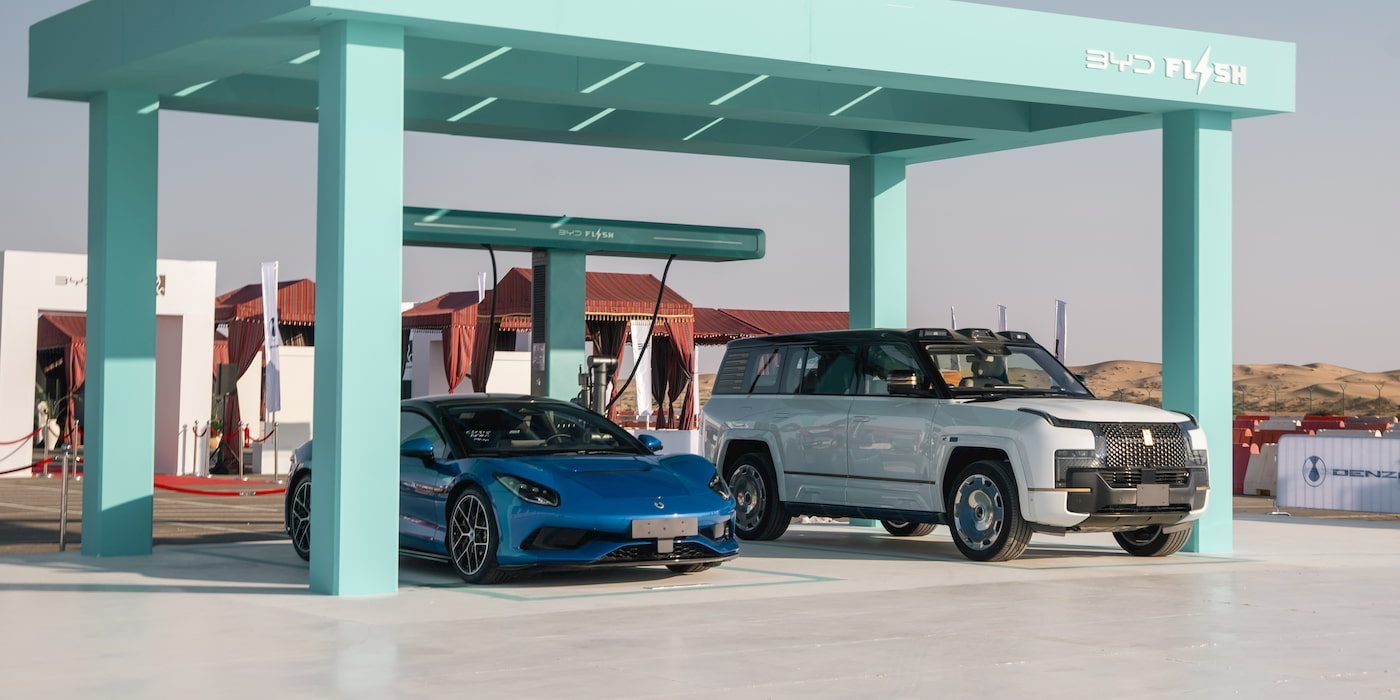
Chinese manufacturer BYD has demonstrated a charging station with a robotic manipulator that automatically inserts the connector into the vehicle, working in tandem with Flash Charging technology.
By Eleanor Ellington · 3 min read
Chinese automaker BYD has shown a robotic charging arm that connects to an electric vehicle on its own. According to Electrek, the manipulator works in tandem with the company's proprietary fast-charging technology, Flash Charging, which, the company says, allows a battery to be fully charged in about five minutes. The announcement was published on November 10, 2026, and is accompanied by a short video demonstrating the system in operation.
The solution's main feature is that there is no need to insert the cable manually. The car pulls up to the station, and the mechanical arm finds the socket and plugs it in by itself. For electric vehicle owners, this eliminates one of the most inconvenient steps of charging, especially in rain, frost, or on a cramped parking spot where the driver has to get out of the car and wrestle with a heavy cable. In this case, automation concerns not only speed but also the convenience of every charging session.
The station is also equipped with an integrated solar generation system. This means that part of the electricity can be generated on site rather than drawn entirely from the grid. This approach fits the broader trend of reducing the load on power systems and increasing the self-sufficiency of charging infrastructure, especially where grid connections are limited or expensive.
The Flash Charging concept behind the station is presented by the manufacturer as a key advantage over conventional charging. The claimed full-charge time of about five minutes is comparable to the usual time needed to refuel a petrol car, and this comparison is what makes the technology stand out in the market. However, the material does not specify the power rating of the equipment or which specific electric vehicle models will be able to work with the system.
It is important to understand that the story is based on a demonstration and the manufacturer's statements. Information on the power of the charging equipment and its compatibility with different batteries is not available in open sources. Nor is there any report on when such stations will go on sale or enter commercial operation, where exactly they are planned to be installed, or how much such a solution will cost operators and drivers.
The claimed five minutes to a full charge have not yet been confirmed by independent real-world testing. Charging time in practice depends on the battery's condition, temperature, initial charge level, and the specific vehicle model, so the claim should be assessed with these factors in mind. Nevertheless, the demonstration itself shows how charging infrastructure may evolve: from manual plugging to fully automated services that require minimal driver involvement and could change the familiar way of using an electric vehicle.
Source: electrek.co
5