
Business 203
Seven Cars With Lease Deals Under £300 a Month
In this issue
Business 203
Seven Cars With Lease Deals Under £300 a Month
Culture 236
Porsche 911 Millennium Edition Heads to Auction With 117k Miles
Economy 38
Diesel at Nearly £11 a Gallon Prompts Calls for VAT Cut at the Pumps
News 149
Weekly Exercise Linked to Slower Memory and Movement Decline in Parkinson's Patie…
Politics 111
Trump Names Katie Zacharia as White House Press Secretary
Sports 266
Arsenal to Host Leeds United in Premier League Clash
Technology 267
Citroën Revives the 2CV as an Electric Car for 2028
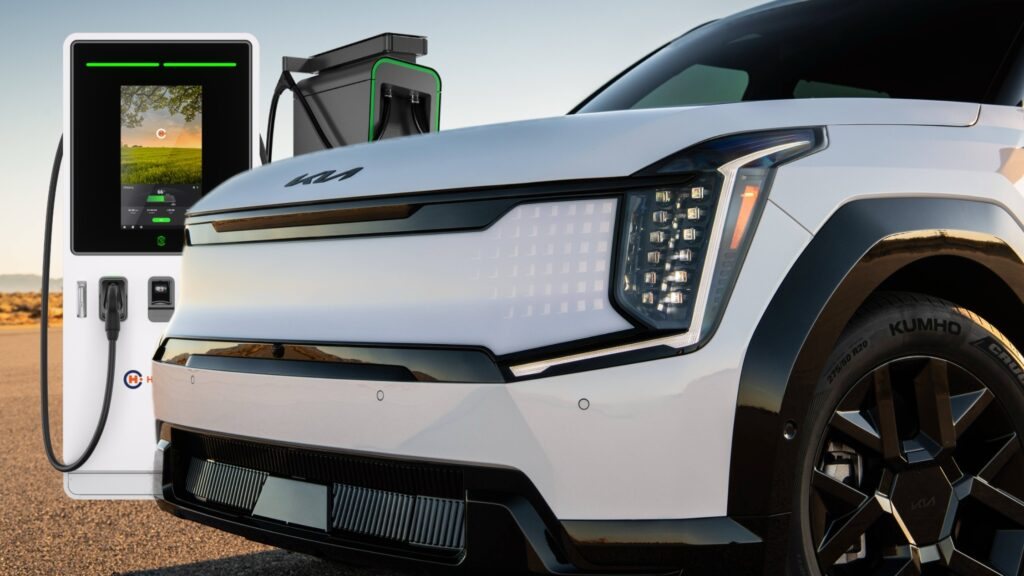
A Canadian Kia EV9 owner was invoiced CAD$22,308 for a charging session that added just 4.91 kWh. The network appears to have kept the session open for over 15 months, billing by time rather than energy delivered.
By George Kensington · 4 min read
A Canadian electric vehicle owner has been presented with a CAD$22,308 (£16,000) bill for a charging session that added just 4.91 kWh to his Kia EV9. The invoice, posted on Reddit by user IntelliDev, shows the session began at 6.57 p.m. on May 17, 2025, but was not electronically closed until 1.09 p.m. on August 25, 2026 — more than 15 months later.
The charging network involved, Hypercharge Networks, appears to have suffered a timing glitch that left the session open long after the vehicle had finished topping up. The invoice itself notes that the session “took place in the past on a terminal that was out of communication,” suggesting the charger stopped delivering power long ago but the network never received the message confirming the session had ended.
Because the charger billed by time rather than by the electrical units actually delivered, the meter kept running. At roughly CAD$2 per hour, the elapsed time between the start and finish dates closely matches the enormous total. The Kia EV9 is one of the faster-charging electric cars on the market, capable of accepting up to 235 kW when connected to suitable equipment. If the bill were accurate, the vehicle would have been charging at less than half a watt per hour — a rate that would make even the slowest home wallbox seem lightning-fast by comparison.
The invoice contains a further inconsistency: it lists the session duration as seven days, 18 hours, 12 minutes and 40 seconds, apparently omitting the preceding year and three months even though the billing calculation appears to have included them. IntelliDev said he emailed Hypercharge to dispute the bill but had not received a response at the time of his latest update. No public explanation has yet been issued by the company.
The incident highlights a growing concern for EV owners as public charging networks expand. While home charging remains inexpensive, public fast charging is already significantly more costly, and billing errors of this scale raise questions about the reliability of the software systems that underpin charging infrastructure. For the Canadian owner, the dispute with Hypercharge may set a precedent for how networks handle such glitches — and whether customers can expect swift corrections when systems fail.
Charging networks typically rely on real-time communication between the charger and their backend servers to close sessions and calculate charges. When that connection is lost or delayed, sessions can remain open indefinitely, as appears to have happened here. The case also underscores the importance of transparent billing practices as EV adoption accelerates, particularly in markets where public charging is essential for drivers without home chargers.
For now, the Kia owner is left waiting for Hypercharge to respond to his dispute. The company has yet to publicly address the incident, and it remains unclear whether other customers have experienced similar issues. The Reddit post has drawn widespread attention, with commenters noting the absurdity of a bill that dwarfs the value of the electricity delivered by a factor of thousands.
57