
Business 199
Honda Elevate Facelift Brings Rugged Styling and Ventilated Seats to India
In this issue
Business 199
Honda Elevate Facelift Brings Rugged Styling and Ventilated Seats to India
Culture 216
Batmobile from Batman Returns heads to auction with $7m estimate
Economy 37
Russia's EV Share Overtakes US as Fuel Shortages Bite
News 148
California Grants Three-Day Return Right on Used Cars
Politics 110
Trump Urges Republicans to Vote by Mail After Years of Criticising the Practice
Sports 262
West Ham United to Host Queens Park Rangers in October 2026 Championship Fixture
Technology 250
BYD Seal 6 Review: A Competent Electric Sedan That Plays It Safe
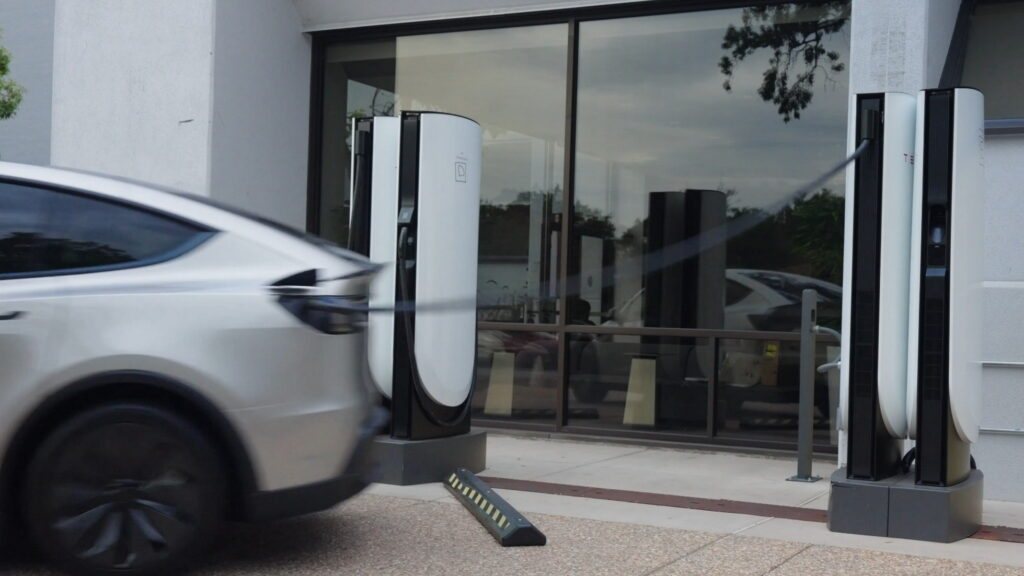
Tesla's new Emergency Drive Away feature allows drivers to shift into Drive while still connected to a Supercharger, overriding the charging interlock. The feature arrives with software update 2026.38.3 and is limited to the US. Tesla warns it will damage both the vehicle and the charger, with repair costs potentially reaching $25,000.
By George Kensington · 4 min read
Tesla has introduced a new software feature that allows its vehicles to drive away from a Supercharger while the charging cable is still attached, overriding the standard safety interlock. The feature, called Emergency Drive Away, arrives with software version 2026.38.3 and is currently limited to the United States.
The system is designed for genuine emergencies only. When a driver attempts to shift into Drive while plugged in, the touchscreen displays an Emergency Drive Away warning. The driver must hold the brake pedal and tap «Activate» on the screen, at which point the usual charging interlock is overridden and the car can move. Tesla has not installed a breakaway connector or any mechanical release mechanism. The car simply pulls away, and the charging cable is ripped free from the Supercharger.
Tesla Charging has been explicit about the consequences. «Use of this feature will damage your vehicle and the Supercharger,» the company warned, adding that deliberate misuse will result in additional penalties. Tesla has not specified what those penalties entail. The company also confirmed that electrical and civil costs associated with repairing a Supercharger can reach $25,000, depending on the station. The vehicle’s charge port will require a mandatory service visit afterward.
A demonstration of the feature shows the charging cable being torn away as the car pulls out, with coolant pouring onto the ground. Tesla confirmed the liquid is glycol and said cleanup will be handled as part of the mandatory Supercharger service visit. The company has not said whether a driver escaping a legitimate emergency will necessarily be handed the full repair bill.
The feature arrives two months after a mass shooting in Twin Falls, Idaho, where a gunman killed three people and injured seven others. Police said the attacker fired at three people inside two Teslas at a nearby Supercharger, killing 66-year-old Dale Schultz. Tesla has not explicitly stated that the shooting prompted the development of Emergency Drive Away. Max de Zegher, a Tesla charging executive, said the company had gone «back and forth on this for years» before deciding to offer it. He described it as «a feature we hope you never need.» The timing, however, is difficult to ignore.
Emergency Drive Away represents a departure from Tesla’s long-standing policy of preventing vehicles from moving while connected to a charger. The company has historically prioritised protecting both the car and the charging infrastructure from damage caused by driver error. The new feature effectively gives the driver permission to break things in exchange for the ability to escape a dangerous situation.
The absence of a breakaway connector is notable. Petrol pumps often include specific breakaway elements that allow the hose to detach safely if a driver pulls away. Tesla’s system does not offer that protection. Instead, the charging hardware is sacrificed. The company’s demonstration makes clear that the resulting damage is both immediate and costly.
Tesla has not indicated whether the feature will be expanded to other markets. For now, it remains a US-only option delivered through an over-the-air software update. The company has also not detailed how it will distinguish between genuine emergencies and deliberate misuse, or how penalties would be applied.
The feature underscores a broader tension in electric vehicle design: the need to protect equipment versus the need to protect people. Tesla’s solution prioritises escape over hardware preservation, a choice that reflects the serious circumstances the feature is intended for. Whether owners will ever need it is another matter. As de Zegher put it, it is a feature Tesla hopes no one ever has to use.
9