
Business 110
Dacia CEO Urges EU to Freeze Small Car Rules to Cut Prices
In this issue
Business 110
Dacia CEO Urges EU to Freeze Small Car Rules to Cut Prices
Culture 89
1988 Porsche 911 Carrera Targa G50 with Rebuilt Engine Heads to Auction
Economy 30
HMRC is writing to low earners about pension top-ups averaging about £70
News 124
Aftermarket Trackers Recover 99% of Stolen Cars as Factory Systems Fail
Politics 104
Met police open inquiry into alleged foreign donations to Reform UK
Sports 230
AMG GT Black Series Spied With Radical Aero Ahead of Nürburgring Record Attempt
Technology 117
BMW Confirms Next 3 Series Will Retain Plug-In Hybrid Power
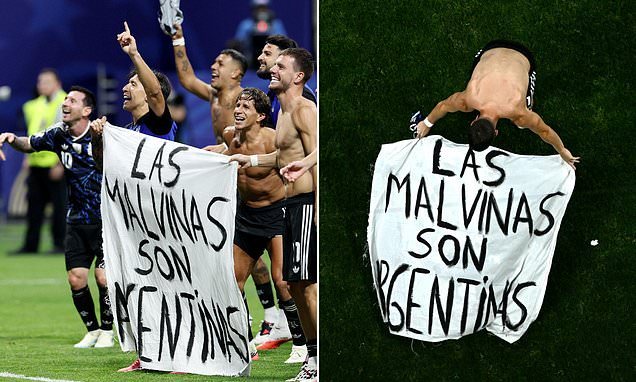
An Argentinian player has defended the team's decision to display a banner claiming the Falkland Islands for Argentina after their World Cup semi-final victory over England, saying the match carried deep historical significance.
By Edward Beaumont · 5 min read
An Argentinian player has defended the team's decision to unfurl a banner proclaiming the Falkland Islands as Argentine territory following their World Cup semi-final victory over England, describing the gesture as a reflection of a «sad part of our history» that «hurts» the nation. The banner, which read «Las Malvinas son Argentinas» — Spanish for «The Falkland Islands are Argentinian» — was displayed by players after the final whistle of the high-stakes match, sparking immediate controversy and drawing sharp responses from the British government and the Falkland Islands Government.
The player, speaking after the game, insisted that the victory was «not just a football match» but carried deeper meaning for Argentina, given the historical context of the 1982 Falklands War. The conflict, which lasted ten weeks, resulted in the deaths of 255 British servicemen, three Falkland Islanders, and 649 Argentine personnel, and remains a deeply sensitive issue in both countries. The banner, held up by the squad during their on-pitch celebrations, was seen by many as a political statement that blurred the line between sport and national grievance.
The Falkland Islands Government swiftly wrote to FIFA expressing their «disappointment» over what they described as an «insensitive» act. In their letter, officials called on football's world governing body to investigate the incident and take appropriate action, arguing that the display was inappropriate for a sporting event. The islands, a British Overseas Territory located about 480 kilometres off the Argentine coast, have been under British control since 1833, though Argentina has long claimed sovereignty, referring to them as the Malvinas.
Downing Street also weighed in, with a spokesperson calling for a FIFA probe into the banner. «The World Cup might not be ours, but the Falklands definitely are,» a defiant No 10 source said, reflecting the UK government's firm stance on the issue. The British position is that the islanders have the right to self-determination, and a 2013 referendum saw 99.8 per cent of voters choose to remain a British Overseas Territory. The banner incident has reignited public debate over the islands' status, with some commentators accusing Argentina of using the World Cup stage to advance a political agenda.
FIFA, which has rules prohibiting political statements at its tournaments, has not yet announced any formal disciplinary proceedings, but the matter is expected to be reviewed. The governing body has previously sanctioned teams for similar displays, including fines and warnings for political messaging during matches. The timing of the incident — immediately after a tense semi-final that saw England eliminated — added to the emotional charge, with images of England players, including Jude Bellingham, being consoled by family members circulating widely on social media.
The Argentinian player's defence of the banner has drawn mixed reactions. Some Argentine fans and commentators have supported the gesture as a legitimate expression of national sentiment, while others have criticised it for injecting politics into sport. In Argentina, the Falklands issue remains a potent symbol of national pride and historical grievance, with annual commemorations and widespread public education on the conflict. The player's comments, describing the banner as a reflection of «a sad part of our history», suggest that the team viewed the act as a moment of collective mourning rather than mere provocation.
The controversy has also highlighted the enduring sensitivity of the Falklands issue in UK-Argentina relations. Diplomatic ties between the two countries have improved in recent years, with agreements on oil exploration and fishing rights, but the sovereignty dispute remains unresolved. The banner incident threatens to strain those relations, particularly if FIFA imposes sanctions on the Argentine Football Association. For now, the focus remains on the World Cup final, but the political fallout from the semi-final is likely to persist, underscoring the complex intersection of sport, history, and national identity.