
Business 148
Tesla begins volume production of Semi electric truck at Nevada plant
In this issue
Business 148
Tesla begins volume production of Semi electric truck at Nevada plant
Culture 153
2021 Toyota Land Cruiser Heritage Edition Heads to Auction
Economy 33
Bitcoin and Ethereum Surge to Levels Last Seen in January
News 132
Sarandon and Einbinder arrested at anti-Netanyahu protest in New York
Politics 108
US Lawmakers Move to Permanently Ban Chinese Cars
Sports 246
Alonso Buys Most Expensive Bugatti Veyron Ever Built
Technology 170
LexisNexis and IMS Bring Driving Scores to Insurer Apps Without Dongles
Synthetic artists will remain playable, but Spotify will stop putting them in front of listeners automatically unless users choose to engage.
By Eleanor Ellington · 4 min read
For years, streaming has trained listeners to expect the next artist to arrive without being asked for. Spotify’s recommendation engine can turn a half-familiar mood into a radio session, a weekly playlist or a chain of new names. From mid-September, that machinery will treat one class of artist differently: AI Personas.
Spotify plans to label profiles whose public identity is generated by AI and does not represent a real person. Those profiles will remain on the service, but their music will be excluded by default from personalised recommendations and editorial selections. A virtual performer can still be heard; Spotify simply will not introduce it automatically in the same way as a human artist.
That makes a small old-fashioned action more important: following. A listener who deliberately follows an AI Persona can signal that the act belongs in their musical world. Spotify says following artists helps improve recommendations. Despite some shorthand descriptions of the change, this is not a requirement to buy a separate Premium subscription or pay extra to hear synthetic acts.
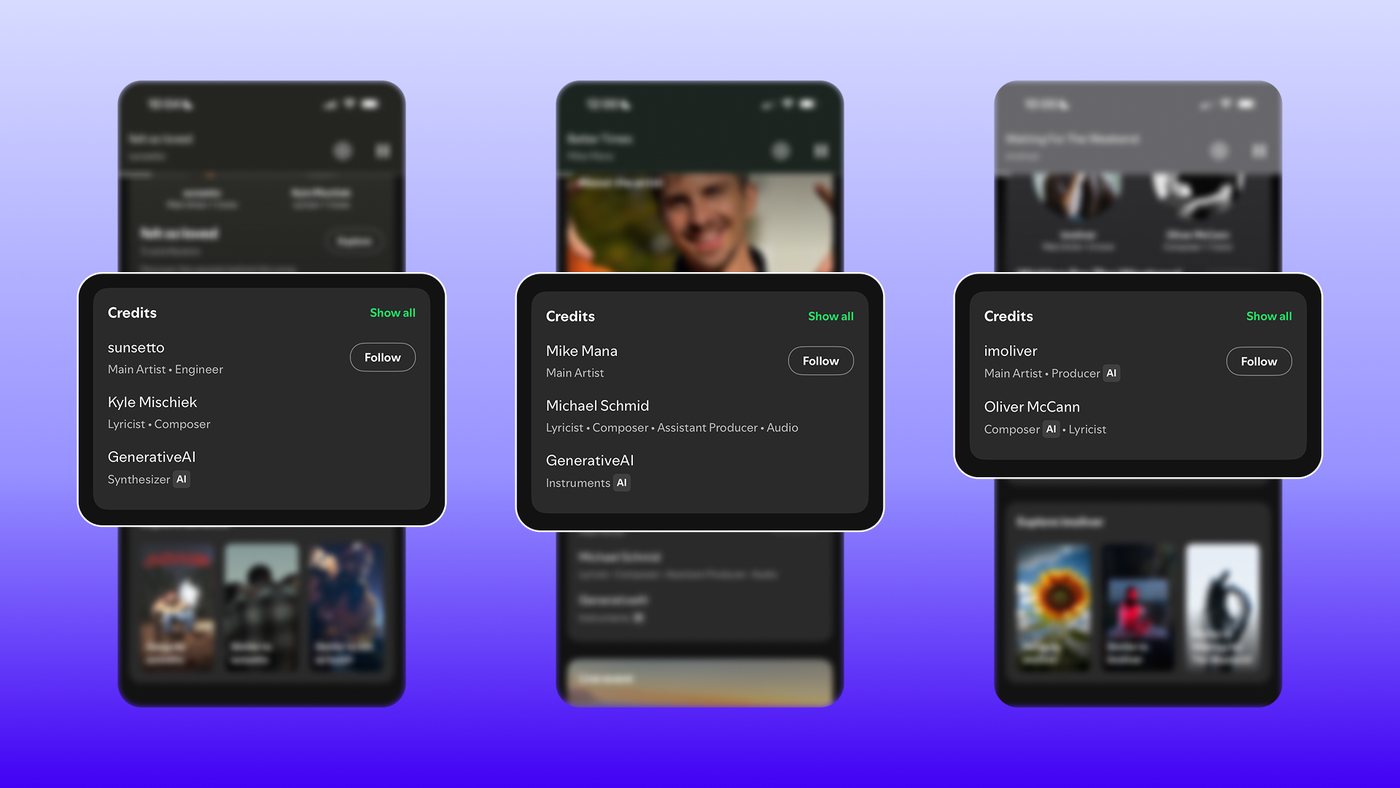
The rule is also more nuanced than “AI music is out.” Spotify is classifying the identity represented on the profile, not scanning for any trace of machine assistance and punishing it. A real musician can use generative tools for lyrics, vocal material, instrumentation or production. The company’s AI credits beta is designed to show those contributions at song level, where they belong.
That separation should matter to anyone who thinks seriously about modern creative tools. Recording technology has always blurred the line between performance and construction. AI extends the blur, but the existence of a tool does not erase authorship. Spotify’s policy effectively says that using AI and pretending an invented person is real are different acts.
Its verification programme follows the same logic. Since April, profiles that primarily represent AI-generated or AI-persona artists have not been eligible for the Verified by Spotify badge. Human artists using AI responsibly can still qualify. Verification is therefore about an authentic person behind the project, not about maintaining a studio free of software.
Spotify will allow creators to declare an AI Persona themselves, but it will also conduct reviews. Human moderators and AI tools will be used, with larger profiles receiving attention first. When the evidence is suggestive rather than conclusive, a “Likely AI Persona” label may appear. There is an appeal route for artists who believe they have been misclassified.
The company has already taken firmer action against clearly abusive uses of generative technology. It removes unauthorised clones of real artists’ voices. In 2025 it also said that more than 75 million spammy tracks had been removed in a 12-month period, as mass generation made it easier to flood streaming catalogs.
The next test will be cultural rather than technical. Some listeners may avoid AI Personas once the label is obvious. Others may not care, provided the music works. A third group may actively seek them out as a new kind of entertainment.
Spotify is leaving all three choices open. What it is withdrawing is the platform’s silent nudge. If a synthetic artist wants to become part of someone’s regular rotation, it will increasingly need the listener to make the first move — a follow, a search, a deliberate play — rather than relying on the algorithm to create the relationship on its behalf.
69