
Business 148
Tesla begins volume production of Semi electric truck at Nevada plant
In this issue
Business 148
Tesla begins volume production of Semi electric truck at Nevada plant
Culture 153
2021 Toyota Land Cruiser Heritage Edition Heads to Auction
Economy 33
Bitcoin and Ethereum Surge to Levels Last Seen in January
News 132
Sarandon and Einbinder arrested at anti-Netanyahu protest in New York
Politics 108
US Lawmakers Move to Permanently Ban Chinese Cars
Sports 246
Alonso Buys Most Expensive Bugatti Veyron Ever Built
Technology 170
LexisNexis and IMS Bring Driving Scores to Insurer Apps Without Dongles
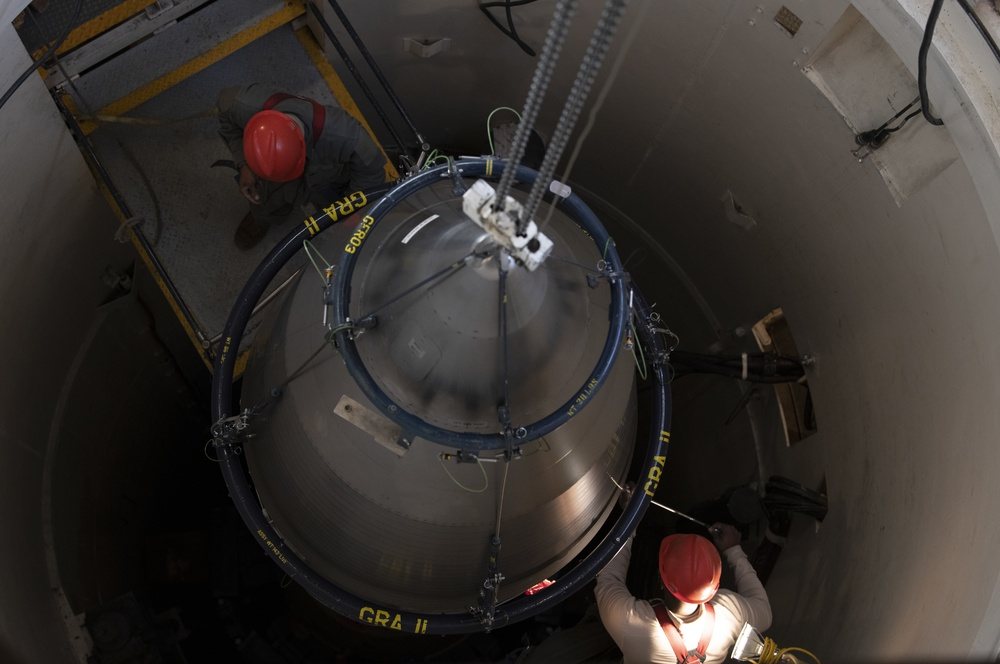
The Air Force is considering AI to search decades of Minuteman III maintenance data. Its design keeps authoritative records and launch command outside the model’s control.
By Eleanor Ellington · 5 min read
Leadership in a high-risk system often comes down to making the right decision with imperfectly organised information. The U.S. Air Force’s proposed AI tool for Minuteman III is aimed at that problem: giving engineers and maintainers faster access to decades of technical records without giving the software authority over the weapon itself.
The Air Force Nuclear Weapons Center has issued a request for information for an AI-powered data aggregation and visualisation tool. The Minuteman III programme, according to its performance work statement, currently relies on roughly 60 disconnected sources that include databases, shared networks and local hard drives.
The information inside them is operationally mundane but strategically important. There are drawings, specifications, technical orders, maintenance logs, supply records, fleet-health metrics, forecasts and risk repositories. A single maintenance question may require a person to move across several of those systems before they can understand the condition of a component or the availability of a replacement.
The Air Force says that manual process makes it harder to assess parts attrition and functional age-out. The first is a supply and reliability problem: components may fail faster than replacements can be sourced. The second is an ageing problem: a part may still exist but be approaching the end of its useful function in a system whose core infrastructure has been operating for more than half a century.
The proposed AI layer would provide one interface for queries and retrieval. It would also improve access to technical visual material such as 2D and 3D drawings and functional diagrams. That could make experienced staff faster and help new personnel understand a complicated system without spending as much time learning where every document lives.
But the most important design choice may be what the AI is not allowed to become. The Air Force says it must not serve as the Authoritative Source of Truth. The system should draw from existing authoritative repositories in near real time, with safeguards and continuous validation to ensure that what a user sees matches the underlying record.
That is a useful model for responsible decision support. A leader can use a fast interface without pretending the interface owns the facts. Traceability and verification remain available, and the machine’s convenience does not erase institutional accountability.
The Air Force has also proposed hard measures of performance: query at least 95 per cent of the initial data sources, achieve 99 per cent search accuracy against source data and reduce manual compilation effort by a measurable amount. Those targets matter because a confident but slightly wrong answer is particularly dangerous when people are making maintenance decisions on strategic equipment.
The nuclear context makes the boundary around authority essential. Nothing in the RFI assigns launch, targeting or command-and-control functions to the AI system. Official Minuteman III material still describes two-officer combat crews on continuous alert in underground launch control centres, connected to national command authorities by a separate redundant communications network.
The data layer will nevertheless be sensitive. The first phase is expected to handle Controlled Unclassified Information at Impact Level 5, and future efforts may extend to Secret data at Impact Level 6. A supplier would need the corresponding security controls and cleared personnel.
Minuteman III entered service in 1970, and the United States still maintains 400 missiles across bases in Wyoming, Montana and North Dakota. Their service lives are being extended while Sentinel is introduced, making reliable sustainment information especially valuable during a long transition.
For now, the Air Force is only asking the market what is possible. The RFI is not a contract. If it advances to procurement, the leadership challenge will be to preserve the same distinction written into the concept: AI can make information easier to reach, but the final responsibility for interpreting that information — and for commanding the weapon — remains human.
68